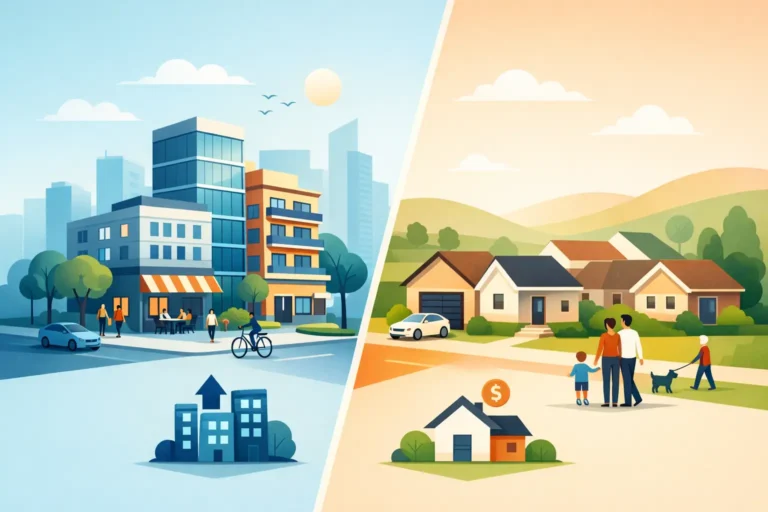
Mixed Use vs Single Use: Which Creates Value?

A well-located site can underperform for years if the development model is wrong. That is why the question of mixed use vs single use is not academic for investors, landowners, or institutional partners. It shapes absorption, tenant stability, asset resilience, and the long-term identity of a district.
In growth markets, the choice is rarely about what is easier to build. It is about what is more intelligent to hold, operate, and position over time. Some sites benefit from a singular purpose with tight operational control. Others gain far more value when residential, retail, hospitality, office, or public-facing components work together as one integrated environment.
Mixed use vs single use: the real difference
Single-use development is exactly what it sounds like. The asset is designed around one primary function, whether that is residential, office, retail, logistics, hospitality, healthcare, or industrial use. Its investment logic is usually clarity. Leasing strategy, design standards, operations, and customer expectations are easier to define when the project serves one market segment.
Mixed-use development combines two or more uses within one project or district. That could mean residential over retail, office connected to hospitality, or a larger ecosystem where commercial, lifestyle, and public-use components reinforce each other. The strongest mixed-use projects are not simply multiple buildings on one site. They are curated environments where each use improves the performance of the others.
This distinction matters because the market does not value every square foot in isolation. It values relevance, convenience, foot traffic, operating synergy, and the strength of the destination. A project with the right mix can create demand that a single-purpose asset may struggle to generate on its own.
Why single-use still wins in some cases
There is a reason many high-performing assets remain single use. Focus can be a strategic advantage.
A single-use project is often faster to conceptualize, finance, and execute. The planning process is cleaner, operational requirements are narrower, and the brand positioning is more direct. For a logistics hub, a hospital, a business park, or a purpose-built residential community, too much complexity can dilute performance rather than improve it.
Single-use assets can also be easier to underwrite. Revenue drivers are more concentrated, tenant profiles are more predictable, and management structures are more streamlined. For institutional capital or owner-operators seeking stable, specialized performance, this can be highly attractive.
There is another advantage that matters in premium markets: excellence through specialization. A luxury hotel, a medical campus, or a major logistics development often performs best when every design and operational decision serves one clear objective. In those cases, singular focus supports efficiency, service quality, and market authority.
That said, concentration creates exposure. When demand softens in one sector, a single-use asset has fewer internal buffers. Its success depends heavily on the health of one market cycle.
Where mixed-use creates stronger strategic value
Mixed-use development becomes compelling when the site has the scale, location, and demand profile to support a broader ecosystem. This is especially true in major urban centers where users increasingly value convenience, experience, and connectivity alongside square footage.
A well-executed mixed-use project can diversify income streams across residential sales or leases, retail rents, hospitality performance, office occupancy, and destination traffic. That diversification does not eliminate risk, but it can improve resilience. If one segment slows temporarily, another may continue to perform.
More importantly, mixed-use projects can create their own gravity. Residents support retail. Retail and dining improve the appeal of residential and hospitality components. Offices bring daytime population. Public-use spaces add relevance and increase dwell time. The result is not just multiple revenue lines, but a stronger overall proposition in the market.
For cities pursuing transformation and higher-quality urban environments, mixed-use developments also align with a bigger ambition. They create places people can use throughout the day rather than isolated properties with limited engagement. In a market such as Riyadh, where scale, modernization, and destination-led development continue to accelerate, that distinction can carry real strategic weight.
The trade-offs behind mixed use vs single use
The premium attached to mixed use is not automatic. Too many projects treat it as a label rather than a discipline.
Mixed-use development is more complex to structure. It requires a sharper understanding of phasing, circulation, parking strategy, infrastructure load, tenant mix, operating models, and customer behavior. The wrong combination of uses can create friction instead of synergy. Residential buyers may resist nightlife traffic. Office users may require access patterns that conflict with hospitality operations. Retail underperformance can weaken the energy of the wider environment.
Capital planning is also more demanding. Different components may lease up or stabilize at different speeds. Some uses generate immediate revenue, while others build longer-term value through placemaking and brand elevation. Developers need the patience, balance sheet discipline, and strategic clarity to manage this complexity without compromising quality.
This is where the mixed use vs single use decision becomes less about trend and more about capability. If the development team lacks the vision or execution capacity to orchestrate multiple uses at a high level, single use may be the smarter path.
How to choose the right model for a site
The right answer starts with the land, not the headline. A project should reflect what the location can realistically support, what the surrounding market lacks, and how the asset is expected to perform over time.
If the site sits in a corridor with deep demand for one dominant function, a single-use scheme may unlock value more efficiently. This is common with specialized healthcare, logistics, education, and certain hospitality formats. The project wins because it serves a focused need better than any hybrid model could.
If the land sits in a high-visibility urban zone with multiple demand drivers, mixed use may produce a stronger long-term outcome. In those settings, the site can support a fuller environment rather than a standalone asset. The development then becomes part of how a district evolves, not just a response to existing demand.
The intended hold strategy matters as well. If the objective is a stabilized, specialized income asset, single use may align more cleanly with operations and exit logic. If the objective is long-horizon appreciation, place creation, and broader value capture across uses, mixed use often has greater upside.
Mixed use vs single use for investors and stakeholders
From an investment perspective, neither model is universally superior. The stronger option is the one that matches market demand, execution capability, and portfolio strategy.
Single-use assets can offer cleaner narratives for financing and operations. They suit investors who value clarity, specialization, and efficient management structures. They can also fit well within diversified portfolios by providing exposure to a specific sector with measurable performance drivers.
Mixed-use projects appeal to stakeholders looking beyond near-term leasing metrics. They can create stronger district positioning, enhance land value, and support premium pricing by delivering experience as well as occupancy. For landowners and public-sector stakeholders, this can be especially meaningful because the project contributes to the broader identity and utility of a place.
That is why leading developers do not approach the choice ideologically. They approach it strategically. Sinwan Real Estate, like other future-oriented developers operating at scale, understands that the highest-value projects are shaped by what a site can become, not by forcing a format onto the land.
The future is not one model
Real estate is moving toward sharper specialization in some sectors and deeper integration in others. Logistics, healthcare, and certain institutional assets will continue to reward focused single-use execution. Urban growth corridors, destination districts, and premium lifestyle environments will continue to favor mixed-use thinking where it is planned with precision.
What matters most is intentionality. Single use should be chosen because focus creates strength. Mixed use should be chosen because integration creates value. In both cases, the winners will be the projects that combine disciplined strategy with a clear vision of how people will live, work, spend, and connect.
The smartest developments do more than fill land. They shape patterns of demand, elevate the surrounding market, and leave behind an asset that remains relevant as the city grows.